Showing posts with label Halloween History. Show all posts

Monday, September 21, 2009

.Séances & Ouija Boards.

In the mid 19th century, the world became fascinated with spiritualism. Spiritualists believed beyond doubt that there was life after death and that people's religious beliefs shouldn't be burdened by structure and rules. This belief was very popular in the United States because people were still trying to shake their Puritan foundations. Mystics and mediums began housing seances to help people communicate with the dead and talking boards were among the methods they used to do so.


.Séances.


The history of séance communication can be traced back to the third century but it was during the 1800's that the séance became popular.

Fox sisters at Hydesville March 1848
(Fox sisters at Hydesville March 1848)


The spiritualism movement began in the United States in a small town in upstate New York called Hydesville with three young women, Leah, Margaretta and Kate Fox who communicated with the dead on the night of March 31st 1848. The most common version of their story is that a few weeks before that night, the Fox family had heard unexplained rapping, footsteps and other noises. On the night of March 31st, Kate Fox suddenly decided to challenge the spirit. She clapped a few times and soon after there were the same amount of taps. Margaretta joined in and finally Mrs. Fox demanded the spirits tap out her daughter's ages-it did, 11 and 13. They eventually assigned a code for letters of the alphabet so they were able to spell out longer and more detailed messages. Continuing dialogue with the spirit revealed that it was the spirit of a man who had been killed and buried in their home. Hair and bone remains were found the following summer and the girls became a world wide sensation. The three sisters found themselves traveling all over the region holding public and private séances.

Their eerie experience set fuel to a flame that spread as far as Europe. People began holding organized séances where they would ask spirits questions that would be answered by a series of raps or knocks. Many messages received from the spirits were proved to be factual and in addition to the messages, other phenomena was being witnessed and verified by many of the most credible people in American and European history.

In 1888, Margaretta Fox confessed that she had been the one making all of the rapping noises with a double-jointed toe. It was said that the eldest sister Leah had taken the majority of their earnings leaving Margaretta and Kate with nothing but their confession of being cheats earned them both a large sum of money. In 1985, Margaretta recanted her confession in writing shortly before she died. In 1905, the Boston Journal reported that the skeleton of a murdered man had been discovered in the walls of the Fox house proving that the sisters had in fact been telling the truth about their capabilities. Despite wether you believe their claims or not, there is no denying the fact that these women will forever be credited with opening up the possibility of seeing, hearing and communicating with the dead.


.Ouija Boards.


Ad for Seance Board


The origins of the concept of the ouija board date all the way back to the fourth century when Emperor Valens ruled Rome and it is believed to have been used by the Greeks before the Christianity came along. The earliest known patent for this concept was filed in London, England by Adolphus Theodore Wagner. He described his product as follows: “PSYCHOGRAPH, OR APPARATUS FOR INDICATING PERSONS THOUGHTS BY THE AGENT OF NERVOUS ELECTRICITY” on January 23, 1854. This patent goes on to describe the device and identify it as a talking board. “The apparatus consists of a combination of rods or pieces of wood joined so as to permit of free action in all parts. From one of the legs of the instrument hangs a tracer; on one or more of the other extremities is fixed a disc, upon which the operator is to place his hand, and from this extremity or these extremities depends another tracer. The other parts of the apparatus consist of a glass slab or other non-conductor, and of an alphabet and set of figures or numerals. Upon a person possessing nervous electricity placing his hand upon one of the discs the instrument will immediately work, and the tracer will spell upon the alphabet what is passing in the operator’s mind.”

The ouija board as we know it today was created in America shortly after the planchette had made its way over seas by a coffin maker from Maryland named E.C. Reiche. He devised a wooden lap tray with the letters of the alphabet arranged in two lines across the center of the board. Below these letters, he placed the numbers 1-10 and the words YES and NO in each lower corner of the board. He used the planchette with his board but removed the pencil tips and placed wooden pegs on the bottom of it. In this way, the planchette was free to move about the board.

1920s Ouija Board by William Fuld


Reiche was more interested in spirits than making money so he sold the invention to his friend, Charles Kennard, who then founded the Kennard Novelty Co. with borrowed money and began the first commercial ouija boards around 1886. The first patent for it was filed on May 28, 1890. After financial backers put Kennard's shop manager, William Fuld in control, the company's name was changed to Ouija Novelty Company and Fuld began claiming the name "Ouija" came from the French and German words for yes, oui and ja. Reiche had formerly said that the board told him Ouija was the Egyptian world for luck.

In 1966, the company was sold to Parker Brothers, who is known for their success with toys and board games, produced replicas of Fuld's board and for a short time, a deluxe wooden edition. They hold all the patents and trademarks to the board which is still produced in large numbers. Despite the fact that it is sold in toy stores, it remains a near duplicate (albeit a cheaper quality) of the Spiritualist board that was sold many years ago.

From the Parker Brothers Ouija Board:
It has always been mysterious. It has always been mystifying. Sit opposite your partner and rest your fingers lightly on the planchette. Now ask your question. Concentrate very hard...and watch as the answer is revealed in the message window. Will it tell you YES...or NO? Will it give you a NUMBER...or SPELL out the answer? Ask any question you want. Ouija will answer. It's only a game isn't it?


While ouija boards and séances are done year round, Halloween has long since the day of the ancient Druids been considered the best time for contacting the spirit world.


.Learn More.


May the dead rise up to greet you =) -

Thursday, September 10, 2009

Another lesson in Hallowed History

.Salem Witch Trials.

Salem Witches


When the year of 1692 began for the village of Salem, things were a mess of turmoil. The English court was seeking clarification of the colony's government, the French were waging war, Indians were on the war path, taxes were becoming intolerable, pirates were attacking commerce and small pox was raging. Not to mention the internal issues, half of the people were farmers who stood by Reverend Parris who was attempting to break away from Salem Town to form their own district township and the other half wanted to remain a part of Salem Town, retaining merchant ties and refused to contribute to the maintenance of Parris and his family. There were also disputes regarding the ownership of land and what its boundaries were all across the small village. The atmosphere was primed and ready for the mass religious hysteria to break out, afterall it was a long standing Puritan belief that Man was inherently evil so it was easy to blame community problems on people who were just the slightest bit different.

Just what was the spark that set the flame?

Tituba, the slave of Rev. Parris, would tell tales of West Indian lore to a group of unmarried yound women. Stories so graphic that Parris' daughter, Elizabeth (aged 9), and her cousin, Abigail Williams (11), were so emotionally excited that they went into fits of sobbing and convulsions. Soon the two girls completely defied the whole adult world showing lawlessness, disobedience, mocking of authority and delinquency. Elizabeth, who had been brought up by the strictest of fathers, threw a bible across the room and got away with it. Abigail took the limelight during a solemn day of fasting on March 11th by shrieking and romping, thereby disrupting the prayers.

Soon a group of older girls began to act out of character as well; they were said to stand at odd postures, make antic gestures and utter foolish ridiculous speeches which neither they themselves nor any others could make sense of. This group of girls was Ann Putnam (12), Elizabeth Hubbard (17), Mary Walcott (16), Mary Warren (20), Mercy Lewis (19), Susan Sheldon (18), and Elizabeth Booth (18). The local physician, Dr. Griggs, who himself harbored a possessed girl in his home (Elizabeth Hubbard), with the local ministers diagnosed witchcraft. Keep in mind, elsewhere in the world, the witchcraft delusion was waning. The last execution in England was in 1685.

Reverend Parris and other upstanding citizens began urging the girls to name those who afflicted them but when the questioning failed to produce names, suggestive questions followed and finally, the girls began to spout names. The first three women to be accused were Sarah Good (the town beggar), Sarah Osborne (a crippled woman) and Tituba.

There was no way to try these people because there was no legitimate form of government. By the time Governor Phips arrived and instituted the Court of Oyer and Terminer (which was to hear and determine), prisoners in the jails of Salem, Boston and surrounding areas had swelled to numbers nearing 80. Before the trials began, Sarah Osborne and Sarah Good's newborn baby girl both died and the majority of the rest were ill.

The preliminary hearing for Sarah Good was basically the testing and practice run for future accusations. The questions asked were not creating evidence to convict the woman so Judge Hawthorn asked the children to look upon her to see if this was indeed the person who had hurt them. They did and said she was then to demonstrate the torment, the girls cried out as if in pain, claimed they were pinched, bit, and paralyzed.

Each girl's story was generally the same for each person they accused and as time passed they became more and more detailed, drawing on things suggested in the court room and suggestions made by others. Tituba was actually the first person to bring up anything about specters or shapes of neighbors trying to win people to the devil. Later they came up with a "touch" test where if the toucher was a witch, the girl's chaotic fits were quieted.

Over the summer, the court heard approximately one case per month. Of the accused, only one was released when the girls recanted their identification of him. All cases that were heard ended with the accused being condemned to death for witchraft. A series of four executions over the summer saw 19 people hanged; six were men and the rest were mostly impoverished women beyond childbearing age. Only one execution during the Salem Witch Trials was not by hanging; Giles Cory was pressed to death. 55 of the 150 accused confessed and received reprieves.

The witch trials ended in October of 1692 even though some people who had been accused and already jailed for witchcraft were not released until the next spring. Officially, the royal appointed governor of Massachusetts, Sir william Phips, ended them after an appeal by Boston-area clergy. In 'Cases of Conscience Concerning Evil Spirits' (published October 3rd, 1692) Increase Mather stated, "It were better than ten suspected witches should escape, than that the innocent person should be condemned."

Theories abound as to why the community of Salem Village exploded into such a chaotic outpour of delusions of witchcraft and demonic invasions. The most common belief is that when this colony of Puritans began to have more royal interference after governing themselves for over 30 years, they went through mass religion-induced hysterical delusion. Others believe this is too simple of an explanation and suggest other theories such as child abuse, fortune telling experiments gone wrong, ergot induced fantasies (ergot is a fungus that grows on damp barley and produces a substance very similar to D-lysergic acid; this could easily be ingested back in pre-industrial society), a teenage prank gone wrong, conspiracy by the Putnam family to destroy their rival-the Porter family, or societal victimization of women.

No one truly knows for sure why the girls began accusing these people of horrible things, but the one thing that will forever remain true in history is that innocent people were tortured and killed.


.Chronology of Events.

Salem Witches


September 6, 1628: Puritans land at Salem from Massachusetts Bay Colony.

1629: Salem is settled.

1641: English law makes witchcraft a capital crime.

1684: England declares that the colonies may not self-govern.

1688: Following an argument with laundress Goody Glover, Boston child Martha Goodwin (aged 13), begins exhibiting bizarre behavior. Days later her younger brother and two sisters start acting a similar way. Glover is arrested and tried for bewitching the Goodwin children. Reverend Cotton Mather meets twice with Glover following her arrest in an attempt to persuade her to repent her witchcraft. She eventually confessed and was hanged. On the way to her execution, Goody Glover named others involved in betwitching the children and said killing her would do nothing. Mather took Martha Goodwin into his own house and her bizarre behavior continued and worsened. Later that year Mather publishes Memorable Providences, Relating to Witchcrafts and Possessions.

November, 1689: Samuel Parris is named the new minister of Salem. Parris moves to Salem from Boston, where Memorable Providence was published.

October 16, 1691: Villagers vow to drive Parris out of Salem and stop contributing to his salary.

January 20, 1692: Eleven-year old Abigail Williams and nine-year-old Elizabeth Parris begin behaving much as the Goodwin children acted four years earlier. Soon Ann Putnam Jr. and other Salem girls begin acting similarly.

Mid-February, 1692: Doctor Griggs, who attends to the "afflicted" girls, suggests that witchcraft may be the cause of their strange behavior.

February 25, 1692: Tituba, at the request of neighbor Mary Sibley, bakes a "witch cake" and feeds it to a dog. According to an English folk remedy, feeding a dog this kind of cake, which contained the urine of the afflicted, would counteract the spell put on Elizabeth and Abigail. The reason the cake is fed to a dog is because the dog is believed a "familiar" of the Devil.

Late-February, 1692: Pressured by ministers and townspeople to say who caused her odd behavior, Elizabeth identifies Tituba. The girls later accuse Sarah Good and Sarah Osborne of witchcraft.

February 29, 1692: Arrest warrants are issued for Tituba, Sarah Good and Sarah Osborne.

March 1, 1692: Magistrates John Hathorne and Jonathan Corwin examine Tituba, Sarah Good, and Sarah Osborne for "witches teats." Tituba confesses to practicing witchcraft and confirms Good and Osborne are her co- conspirators.

March 11, 1692: Ann Putnam Jr. shows symptoms of affliction by witchcraft. Mercy Lewis, Mary Walcott, and Mary Warren later allege affliction as well.

March 12, 1692: Ann Putnam Jr. accuses Martha Cory of witchcraft.

March 19. 1692: Abigail Williams denounces Rebecca Nurse as a witch.

March 21, 1692: Magistrates Hathorne and Corwin examine Martha Cory.

March 23, 1692: Salem Marshal Deputy Samuel Brabrook arrests four-year-old Dorcas Good. Edward and Jonathan Putnam file complaints against Rebecca Nurse.

March 24, 1692: Corwin and Hathorne examine Rebecca Nurse.

March 26, 1692: Hathorne and Corwin interrogate Dorcas.

March 28, 1692: Elizabeth Proctor is accused of witchcraft.

April 3, 1692: Sarah Cloyce, after defending her sister, Rebecca Nurse, is accused of witchcraft.

April 11, 1692: Hathorne and Corwin examine Sarah Cloyce and Elizabeth Proctor. On the same day Elizabeth's husband, John, who protested the examination of his wife, becomes the first man accused of witchcraft and is incarcerated.

Early April, 1692: The Proctors' servant and accuser, Mary Warren, admits lying and accuses the other accusing girls of lying.

April 13, 1692: Ann Putnam Jr. accuses Giles Cory of witchcraft and alleges that a man who died at Cory's house also haunts her.

April 19, 1692: Abigail Hobbs, Bridget Bishop, Giles Cory and Mary Warren are examined. Deliverance Hobbs confesses to practicing witchcraft. Mary Warren reverses her statement made in early April and rejoins the accusers.

April 22, 1692: Mary Easty, another of Rebecca Nurse's sisters who defended her, is examined by Hathorne and Corwin. Hathorne and Corwin also examine Nehemiah Abbott, William and Deliverance Hobbs, Edward and Sarah Bishop, Mary Black, Sarah Wildes, and Mary English.

April 30, 1692: Several girls accuse former Salem minister George Burroughs of witchcraft.

May 2, 1692: Hathorne and Corwin examine Sarah Morey, Lydia Dustin, Susannah Martin and Dorcas Hoar.

May 4, 1692: George Burroughs is arrested in Maine.

May 7, 1692: George Burroughs is returned to Salem and placed in jail.

May 9, 1692: Corwin and Hathorne examine Burroughs and Sarah Churchill. Burroughs is moved to a Boston jail.

May 10, 1692: Corwin and Hathorne examine George Jacobs, Sr. and his granddaughter Margaret Jacobs. Sarah Osborne dies in prison.

May 14, 1692: Increase Mather and Sir William Phipps, the newly elected governor of the colony, arrive in Boston. They bring with them a charter ending the 1684 prohibition of self-governance within the colony.

May 18, 1692: Mary Easty is released from prison. Following protest by her accusers, she is again arrested. Roger Toothaker is also arrested on charges of witchcraft.

May 27, 1692: Phipps issues a commission for a Court of Oyer and Terminer and appoints as judges John Hathorne, Nathaniel Saltonstall, Bartholomew Gedney, Peter Sergeant, Samuel Sewall, Wait Still Winthrop, and Lieutenant Governor William Stoughton.

May 31, 1692: Hathorne, Corwin and Gednew examine Martha Carrier, John Alden, Wilmott Redd, Elizabeth Howe and Phillip English. English and Alden later escape prison and do not return to Salem until after the trials end.

June 2, 1692: Bridget Bishop is the first to be tried and convicted of witchcraft. She is sentenced to die.

June 8, 1692: Eighteen year old Elizabeth Booth shows symptoms of affliction by witchcraft.

June 10, 1692: Bridget Bishop is hanged at Gallows Hill. Following the hanging, Nathaniel Saltonstall resigns from the court and is replaced by Corwin.

June 15, 1692: Cotton Mather writes a letter requesting the court not use spectral evidence as a standard and urging that the trials be speedy. The Court of Oyer and Terminer pays more attention to the request for speed and less attention to the criticism of spectral evidence.

June 16, 1692: Roger Toothaker dies in prison.

June 29-30, 1692: Rebecca Nurse, Susannah Martin, Sarah Wildes, Sarah Good, and Elizabeth Howe are tried, pronounced guilty and sentenced to hang.

July 19, 1692: Rebecca Nurse, Susannah Martin, Elizabeth Howe, Sarah Good and Sarah Wildes are hanged at Gallows Hill.

July 23, 1962: Fearing that they can't get a fair trial in Salem village, John Proctor and other prisoners write a letter from prison to the Reverends Increase Mather, James Allen, Joshua Moody, Samuel Willard, and John Bayley in an attempt to gain their support for a change of venue.

August 5, 1692: George Jacobs Sr., Martha Carrier, George Burroughs, John Willard and John and Elizabeth Proctor are pronounced guilty and sentenced to hang.

August 19, 1692: George Jacobs Sr., Martha Carrier, George Burroughs, John Willard and John Proctor are hanged on Gallows Hill. Elizabeth Proctor is not hanged because she is pregnant.

August 20, 1692: Margaret Jacobs recants the testimony that led to the execution of her grandfather George Jacobs Sr. and Burroughs.

September 9, 1692: Martha Corey, Mary Easty, Alice Parker, Ann Pudeator, Dorcas Hoar and Mary Bradbury are pronounced guilty and sentenced to hang.

Mid-September, 1692: Giles Cory is indicted.

September 17, 1692: Margaret Scott, Wilmott Redd, Samuel Wardwell, Mary Parker, Abigail Faulkner, Rebecca Earnes, Mary Lacy, Ann Foster and Abigail Hobbs are tried and sentenced to hang.

September 19, 1692: Sheriffs administer Piene Forte Et Dure (pressing) to Giles Cory after he refuses to enter a plea to the charges of witchcraft against him. After two days under the weight, Cory dies.

September 22, 1692: Martha Cory, Margaret Scott, Mary Easty, Alice Parker, Ann Pudeator, Willmott Redd, Samuel Wardwell, and Mary Parker are hanged. Hoar escapes execution by confessing. Mary Herrick of Wenham, Mass. reported that the ghost of Mary Easty appeared to her and proclaimed her innocence of witchcraft.

October 3, 1692: The Reverend Increase Mather, President of Harvard College and father to Cotton Mather, denounces the use of spectral evidence.

October 5, 1692: Five-year old Dorcas Good, daughter of a poor laborer imprisoned since May, is finally released when her father was able to raise bail.

October 8, 1692: Governor Phipps orders that spectral evidence no longer be admitted in witchcraft trials.

October 29, 1692: Phipps prohibits further arrests, releases many accused witches, and dissolves the Court of Oyer and Terminer.

November 25, 1692: The General Court establishes a Superior Court to try remaining witches.

January 3, 1693: Judge Stoughton orders execution of all suspected witches who were exempted by their pregnancy. Phipps denied enforcement of the order causing Stoughton to leave the bench.

January 1693: 49 of the 52 surviving people brought into court on witchcraft charges are released because their arrests were based on spectral evidence. Lydia Dustin was one of the aquitted but had no one to come to her financial aid so she died in jail.

1693: Tituba is released from jail and sold to a new master.

May 1693: Phipps pardons those still in prison on witchcraft charges.

November 26, 1693: Parris gives his "Meditation for Peace" sermon, in which he admited to giving too much weight to spectral evidence.

January 14, 1697: The General Court orders a day of fasting and soul-searching for the tragedy at Salem. Moved, Samuel Sewall publicly confesses error and guilt.

1697: Minister Samuel Parris is ousted as minister in Salem and replaced by Joseph Green.

1702: The General Court declares the 1692 trials unlawful.

1706: At the age of 26, Ann Putnam Jr., one of the leading accusers, publicly apologizes for her actions in 1692.

1711: The colony passes a legislative bill restoring the rights and good names of those accused of witchcraft and grants 600 pounds in restitution to their heirs.

1752: Salem Village is renamed Danvers.

1957: Massachusetts formally apologizes for the events of 1692.

1992: On the 300th anniversary of the trials, a witchcraft memorial designed by James Cutler is dedicated in Salem.


.Books on the Salem Witch Trials.


Because knowledge rocks~ Until next time....

Wednesday, September 2, 2009

Hallowed History...

.Trick or Treating.

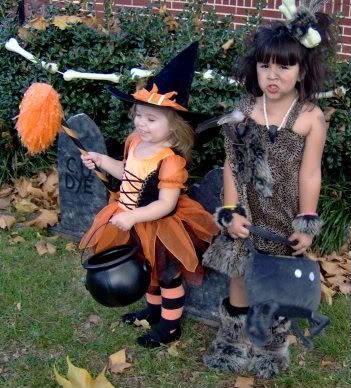
My bewitching daughter and her cousin Lexi the cave girl


Trick or treating as we know it today is a blend of several ancient and modern influences.

In ancient Celtic times (Ireland somewhere around 800 B.C.) the children in Celtic society would walk door to door to collect firewood for a giant communal bonfire which was the main event of their Samhain celebration. Once the bonfire was burning, they would extinguish all the other fires in the village then relight every fire with a flame taken from the Samhain bonfire, as a symbol of their connection to on another.

In 9th century europe, a popular All Soul's Day practice was to make 'Soul Cakes', which were simply a bread dessert with a current topping. Much like our trick or treating today, people would walk from village to village offering prayers for the dead in return for gifts of food in a practice that was called 'Souling'. The prayers were said to help the person's relatives find their way out of purgatory and into heaven.

In other medieval times, in places such as Ireland and the British Isles, costumed adults and older teens would go from house to house demanding beer and food items in exchange for small performances.

In 1930's America, adults began looking for ways to control the increasingly dangerous and expensive vandalism which happened on Halloween, so they began giving out bribes to the kids to distract them from the mischief. The term 'trick or treat" finally appears in print around 1939.

With typically more than 85% of U.S. households handing out candy on Halloween night, All Hallows Eve is the number one holiday for candy sales according to the National Confectioners Association, beating out Christmas, Easter and Valentines Day.


.Pranks.

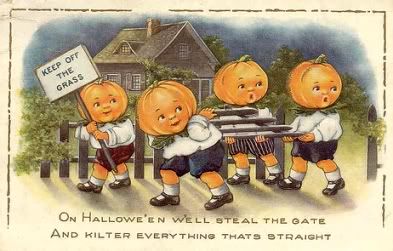
Vintage Halloween Postcard Pranking Pumpkins


Who would have thought that the fun loving-sometimes vicious-pranks that happen each Halloween would have roots that date all the way back to around 800 B.C. in Ireland?

Like all early societies, the Celts were very structured and organized-but during Samhain celebrations, which lasted from October 31st to November 2nd, order and structure were thrown out the window and chaos reigned. People would do crazy things such as moving people's horses to different fields and they also unhinged farmers gates and left them in ditches.

In 19th century America, rural immigrants from Ireland and Scotland brought Halloween customs from from their homelands and one of those traditions was that on Halloween night, the boys would roam the outdoors engaging in almost ritualized pranks. At that time, the favorite pranks in New England included tipping over outhouses and unhinging fence gates. The next day, the pranks were blamed on unruly spirits.

In 1930's America, when pranks got increasingly more expensive and dangerous, householders began giving out bribes to the neighborhood kids as a way to distract them away from their previous anarchy.


Hope you enjoyed this Halloween History lesson!


(Note: The two little trick-or-treaters are my bewitching little girl Zoey and my cave girl niece Lexi.)

Saturday, August 29, 2009

More Hallowed History...


.Pumpkins.
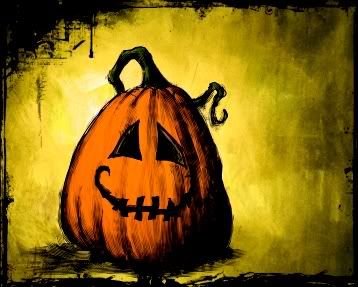
Cute Pumpkin graphic


The jack o' lantern has a long history that originates all the way back to around 800 B.C. when Celtic society would bring home an ember from the communal bonfire at the end of their Samhain celebration. They carried these embers in hollowed-out turnips which created a lantern that resembles the modern day jack o' lantern. However, the turnips that they used are not the turnips we know today, rather than being white and purple skinned- its yellow and purple, they are between half a foot and a foot in diameter big and known in English as a 'swede'.

Such Celtic traditions remained a significant part of the national culture in 18th century Ireland and the direct predecessor of jack 0' lanterns comes from a very popular character from Irish folklore. The tale is about a man named Jack, who was notorious for being a drunkard and trickster. He was said to have tricked Satan into climbing up a tree for some apples and then he carved crosses all around the trunk so he could not climb down. Jack then made a deal with the devil that if he would never tempt him again-he'd let him down the tree. When Jack eventually died, he was turned away from Heaven due to his life of sin and, in keeping with their agreement, the Devil wouldn't take him either. He was cursed to travel forever as a spirit in limbo with an ember placed inside a hollowed-out turnip to light his way through the darkness.

Using a turnip became a very popular Halloween decoration in Ireland and Scotland a few hundred years ago, using them to ward off Jack and other spirits. Jack o' lantern's finally made their way to the states in the 19th century when Irish families began to immigrate over bringing their traditions with them. They discovered pumpkins here and began to use them instead since they were much easier to carve.

References to pumpkins date back many centuries. The name pumpkin originated from the Greek word for "large melon" which is "pepon." "Pepon" was nasalized by the French into "pompon." The English changed "pompon" to "Pumpion." American colonists changed "pumpion" into "pumpkin."


.Pumpkin Facts.


* Pumpkins have been grown in North America for five thousand years. They are indigenous to the western hemisphere.
* Pumpkins range in size from less than a pound to over 1,000 pounds.
* The largest pumpkin ever grown weighed 1,140 pounds.
* Pumpkins are 90 percent water.
* Pumpkin flowers are edible.
* Native Americans called pumpkins "isqoutm" squash.
* Pumpkins are fruits. A pumpkin is a type of squash and is a member of the gourd family (Cucurbitacae), which include squash, cucumbers, gherkins, and melons.
* Pumpkins were once recommended for removing freckles and curing snake bites.
* Pumpkin seeds should be planted between the last week of May and the middle of June. They take between 90 and 120 days to grow and are picked in October when they are bright orange in color. Their seeds can be saved to grow new pumpkins the next year.


.Jack-O-Lantern Tips.


* After carving pumpkin, coat inside and all cut holes with petroleum jelly (slows shriveling/drying out process).
* Freeze your candles before you put them in the pumpkin, they will last longer.
* Or use battery light or glow stick instead of candles to increase life (candles are much hotter).
* Sprinkle cinnamon or nutmeg on underside of lid when using candles (smells like pumpkin pie).


Until next time...

More Hallowed History...

There are certain things you think of when you think of October and Halloween and they are all rooted deep in traditions from as far back as ancient Celtic culture. Here is some more Halloween history.

.Bobbing for Apples.
Vintage Halloween Postcard Bobbing for Apples


Halloween has long since been said to be a magical time and traditional festivities usually included several divination rituals. In Celtic tradition, apples were associated with female deities who controlled the ways of love so the fruit was used in many marriage divinations. One of the most popular of the time was for young unmarried people to try to bite into an apple floating in water or hanging from a string. It was said that the first person that bit into the apple would be the next one to marry.

In the first century A.D., Celtic practices were adopted by the Romans and Samhain was assimilated into some of the other Roman traditions such as their day to honor Pomona. Pomona is the goddess of fruits and trees and her symbol is the apple.

Apples are still a big part of Halloween celebrations today. In addition to bobbing for Apples, we make candy apples, drink apple cider and some people even hand out apples to trick or treaters.


.Candy Corn.
Candy Corn


For most of us, candy corn goes hand in hand with Halloween. You either love the sugary sweetness or are disgusted by it's main ingredients; sugar, corn syrup and wax. Either way, candy corn wont be going anywhere for a long time to come.

Candy corn was invented in the 1880's by an unknown party but the Wunderle Candy Company of Philadelphia was the first to go into commercial production of the treat. However, the company which is most associated with it is the Goelitz Confectionary Company who began commercial production of candy corn in 1898 in Cincinnati and is today the oldest manufacturer of the Halloween icon.

Making candy back then wasn't the highly mechanized year round job it is today. They manufactured it seasonally from March through November, and it was all man made. The tricolor design was revolutionary for its time, this tedious task was accomplished by men called stringers who would walk backward pouring the steaming candy mixture into trays of corn starch imprinted with kernal shaped molds. Three passes were made, one for each color.

Though these days, computers and machines aid most of the production, candy corn has remained virtually unchanged for well over 100 years. In 2001, according to the National Confectioners Association, manufacturers sold more than 20 million pounds of candy corn.


.Costumes.
My Daughter Zoey on her first Halloween


Dressing up in a costume for Halloween is one of the main staples of this holiday but can you believe that it started because people were trying to scare off ghosts?

Celtic society believed that during Samhain, the disembodied spirits of all those who had died throughout the preceding year would come back in search of living bodies to possess for the next year. Naturally, the still-living did not want to be possessed, so on the night of October 31st, villagers would dress up in all manor of goulish costumes and noisily paraded around the neighborhood, in order to frighten away spirits looking for bodies to possess.

(P.S > The baby in the Little Red Riding Hood costume is my little girl Zoey on her first Halloween. My mom made this amazing costume for her. So cute, right? =)

Until next time...


Photos: Bobbing for apples is from the Flickr photo group Vintage Halloween, Candy Corn is from Tamelyn on Flickr and of course the baby is MINE =) lol.

The Hallowed History of Halloween...

Hi, welcome to my blog Octoberlicious. Fall is my favorite season, October is my favorite month and Halloween is my favorite holiday. So when thinking about a blog I could actually keep up with and WANT to keep up with, I figured why not impart my Octoberlicious knowledge upon the blogosphere. So welcome to all the readers and enjoy! Please feel free to comment and write whenever you want. If you have a certain topic you want to see covered, drop me a line at dark-bride@hotmail.com. Lets get this rolling with a little history =)


.Where It All Began.

5th Century B.C. Celtic Headstone


The origins of this spooky day go all the way back to 5th century B.C. in Celtic Ireland. It appears that the Paleopagan Druid and Celtic societies celebrated four major holidays: Samhain, Oimelc, Beltane and Lughnasadh. Samhain (pronounced Sow-en) was the begining of the winter half of the year and most scholars believe it was the Celtic New Year. Their celebrations lasted three days, with the day before Samhain being the last day of Summer and the day after being the first day of Winter. Samhain was (and still is) said to be very magical due to it falling between seasons (or years).

.A Christian Holiday Afterall.

With the coming of Christianity, this festival was turned into Hallow-e'en (October 31st), All Saints Day (November 1st) and All Souls Day (November 2nd). The Christian Church was unable to stop people from celebrating the holiday so they twisted a few things to match their agendas and gave it a new name which was the same thing they did with some of the other Paleopagan holidays and customs.


.Coming to America.

Vintage Halloween Postcard


Halloween wasn't brought to America until the 1840's when Irish immigrants who were fleeing their country's potato famine came over and brought their traditions with them. In the beginning of the 20th century Halloween resembled something more like Valentine's Day than the Halloween of spooks and gore that we are accustomed to today. Parties were the rage where bobbing for apples wasn't just a game but a chance to search the omens found in apple seeds and peels. Auguries in candle flames, in pumpkins, seeds, nuts and mirrors all were employed by the curious to find out who their future romantic interest would be. You would frequently see images of cupid in the postcards of the era. In the 1930's Halloween was referred to as Beggar's Night and this is when the curve towards today's Halloween started to happen.

.What's In A Name.

Samhain became All Hallows Eve when the Catholic Church changed it. Then All Hallows Eve was contracted to Hallow-e'en and finally to what we all know today, Halloween.

Until next time...